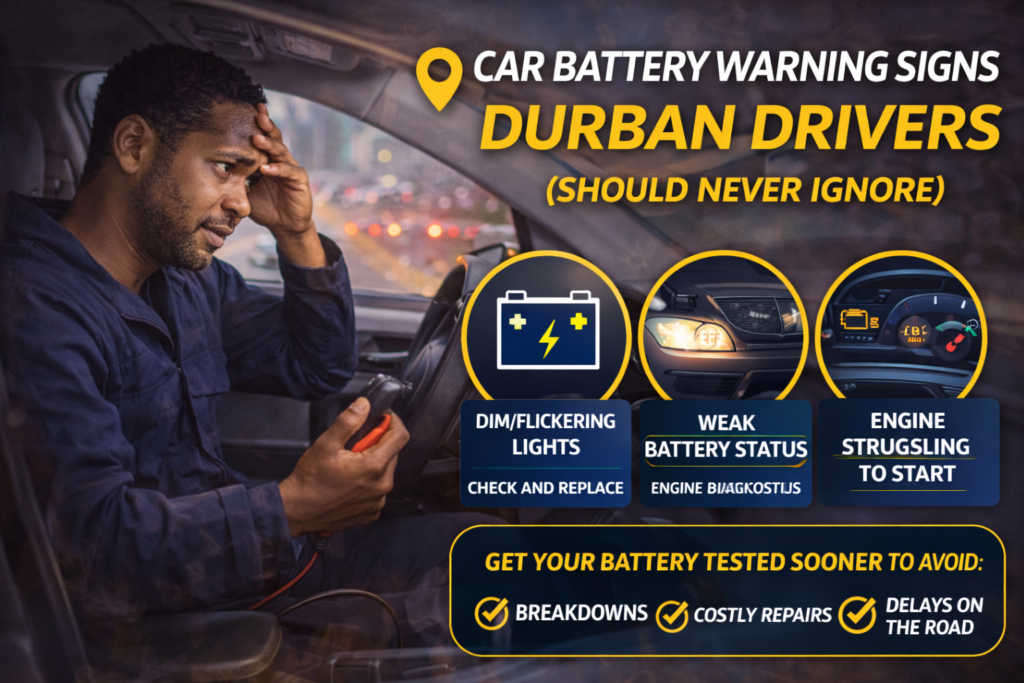
Car Battery Warning Signs Durban Drivers Should Never Ignore
A weak car battery rarely fails without warning. In many cases, the early signs appear days or even weeks before the vehicle refuses to start. Because Durban drivers often deal with stop-start traffic, short trips, coastal humidity, and heavy electrical usage, battery problems can show up faster than expected.
This guide explains the most common battery warning signs, what usually causes them, when the issue becomes urgent, and how to avoid getting stranded. More importantly, it helps you understand when the battery is the real problem and when another fault is actually to blame.
Battery trouble can look simple at first. However, a flat battery can also be the result of a failing alternator, a parasitic drain, poor connections, or repeated short-distance driving. For that reason, proper diagnosis matters just as much as replacement.
Why battery problems are common in Durban
Durban’s climate and driving conditions create a perfect environment for battery stress. Firstly, heat speeds up chemical wear inside the battery. Although many drivers assume cold weather is the main enemy, high temperatures often shorten battery life even faster. Secondly, humidity and coastal air can affect terminals and cable connections over time. As corrosion builds, the battery may struggle to deliver power consistently.
In addition, many vehicles in Durban spend a lot of time in traffic. During heavy stop-start driving, the battery and charging system work harder, especially when lights, wipers, sound systems, chargers, and air conditioning are in constant use. Short local trips also make things worse because the alternator may not have enough time to fully recharge the battery between starts.
Consequently, what begins as a minor weakness can quickly become a no-start situation. If you already suspect a charging-system issue, it is worth checking your alternator and starter repairs in Durban page as well, because battery symptoms and alternator symptoms often overlap.
The earliest warning signs of a weak battery
Most batteries do not fail instantly. Instead, they usually give subtle clues before total failure. One of the earliest signs is a slower-than-normal engine crank when you turn the key or press the start button. Rather than starting sharply, the engine may sound lazy, hesitant, or slightly strained. At first, this may only happen in the morning. Later on, it can become a daily problem.
Another common clue is dimming lights. For example, your headlights may seem weaker at idle, interior lights may fade slightly during startup, or the dashboard may flicker for a moment. Although this can point to charging issues too, a tired battery is often involved. Furthermore, some drivers notice that electric windows move more slowly, the infotainment system resets, or warning lights briefly appear and disappear.
Just as importantly, inconsistent starting should never be ignored. If the car starts fine one day and struggles the next, the battery could be nearing the end of its life. At that stage, waiting usually leads to inconvenience at the worst possible time.
Common battery warning signs to watch for
- Slow engine cranking when starting
- Clicking sound instead of a full start
- Dim headlights or flickering interior lights
- Dashboard battery warning light
- Electrical accessories behaving strangely
- Battery older than expected service life
- Corroded terminals or loose battery clamps
- Repeated need for jump-starts
When the battery warning light comes on
Many drivers assume the battery warning light means the battery itself must be replaced. In reality, that light often points to the charging system rather than the battery alone. For instance, a failing alternator, a slipping belt, poor wiring, or a connection issue can trigger the same warning. Therefore, replacing the battery without testing the charging system can waste money and delay the real fix.
If the warning light appears together with dim lights, hard starting, or electrical issues, the problem should be checked as soon as possible. Moreover, if the light stays on while driving, the vehicle may be running on battery power only. Once that stored power drops too low, the engine can shut down completely.
Because of that risk, it helps to combine battery testing with a proper car diagnostics service in Durban. Accurate diagnosis protects both your budget and your time.
Battery problem or alternator problem? How to tell the difference
This is one of the most important distinctions a driver can understand. A battery stores energy so the vehicle can start. By contrast, the alternator recharges the battery while the engine is running. If the battery is weak but the alternator is healthy, the car may still run normally after a jump-start, at least for a while. On the other hand, if the alternator is failing, the battery may keep going flat again and again even after replacement or charging.
Several clues help separate the two. A battery issue often shows itself most clearly during startup. Meanwhile, an alternator issue may cause the car to start and then develop electrical problems while driving. In some situations, the engine may even stall after a short time because the battery is no longer being recharged.
Similarly, if your vehicle has repeated no-start situations, you should also review the car won’t start Durban page, since the same symptom can come from the battery, starter, alternator, or wiring.
What usually causes a battery to fail
Batteries fail for several reasons, and not all of them are age-related. Naturally, age still matters. Most car batteries weaken gradually over time, especially in warm climates. Even so, a newer battery can also fail early if the vehicle has another problem that keeps draining it.
Short trips are one major factor. Since each start uses a large amount of power, repeated short journeys can leave the battery undercharged. Additionally, leaving lights on, running aftermarket accessories, or having a hidden electrical drain can flatten the battery overnight. Corroded terminals also reduce charging efficiency and starting power. In other cases, vibration, loose mounting, or internal battery damage can shorten lifespan.
For that reason, replacing the battery without checking the full system is not always enough. A good inspection should include terminal condition, charging voltage, cable integrity, and battery health under load.
When a weak battery becomes an emergency
Sometimes a weak battery is just inconvenient. At other times, it becomes a genuine breakdown risk. For example, if the vehicle clicks repeatedly and refuses to crank, you may not be able to leave home, work, or a parking area. Likewise, if the battery warning light appears while driving and electrical systems begin to fail, you could lose reliability very quickly.
Certain situations are more urgent than others. Night driving, rainy conditions, school runs, long commutes, and isolated roadside stops all increase the risk. Accordingly, you should treat repeated jump-starts, flickering dashboard lights, or sudden stalling as warning signs that need immediate attention.
In urgent cases, contacting an emergency mobile mechanic in Durban is the safer option than hoping the car will restart later.
How a mobile mechanic diagnoses battery-related issues
Proper testing goes far beyond checking whether the car starts. First, the battery itself should be tested for voltage and condition under load. Next, the charging system should be checked to confirm whether the alternator is supplying enough power. After that, cables, clamps, and terminals should be inspected for looseness, corrosion, or heat damage.
In addition, a technician may check for abnormal power drains when the vehicle is off. This is especially important if the battery goes flat overnight or after standing for a day or two. Where necessary, fault-code scanning can also reveal charging and electrical-system issues that are not obvious from visual inspection alone.
As a result, the repair plan becomes far more accurate. Instead of guessing, you get a clear answer on whether the battery should be replaced, recharged, secured, or supported by further electrical repairs.
How Durban drivers can extend battery life
Prevention is always cheaper than a roadside failure. To begin with, keep the battery terminals clean and make sure the battery is firmly mounted. Loose connections can reduce starting performance and charging efficiency. Next, avoid unnecessary short trips whenever possible, especially if the battery is already older. Combining errands into a longer drive can help the alternator restore charge more effectively.
Equally important, keep up with regular servicing. During a proper inspection, battery condition, charging performance, belts, and cable connections can be checked before they become a problem. If you want to reduce the chance of unexpected electrical issues, routine car servicing in Durban is one of the smartest steps you can take.
Finally, do not ignore minor symptoms. A battery that cranks slowly today can become a complete no-start tomorrow.
Safety tips if your car won’t start
If the car refuses to start, stay calm and avoid repeated cranking for long periods. Excessive attempts can place extra strain on the battery, starter, and wiring.
- Switch off lights, radio, and accessories
- Check whether terminals look loose or badly corroded
- Avoid jump-start attempts if you are unsure of the procedure
- Move the vehicle only if it is safe and practical to do so
- Get proper testing before replacing parts blindly
Frequently asked questions
How do I know if my battery is dying?
Usually, the first clues are slow cranking, dim lights, electrical glitches, or repeated jump-starts. However, proper testing is the best way to confirm it.
Can a bad alternator look like a bad battery?
Yes. In fact, that is very common. A failing alternator may cause the battery to keep going flat even after charging or replacement.
Should I replace the battery as soon as it gets weak?
Not always. Firstly, test it. Then confirm whether the charging system and connections are working correctly.
Can Durban heat reduce battery life?
Yes. Heat accelerates internal wear, so batteries in warm climates often fail sooner than expected.
Need help with a battery problem in Durban?
If your car is cranking slowly, clicking, going flat repeatedly, or showing battery-related warning signs, get it checked before it leaves you stranded. We diagnose starting and charging issues at your location across Durban.