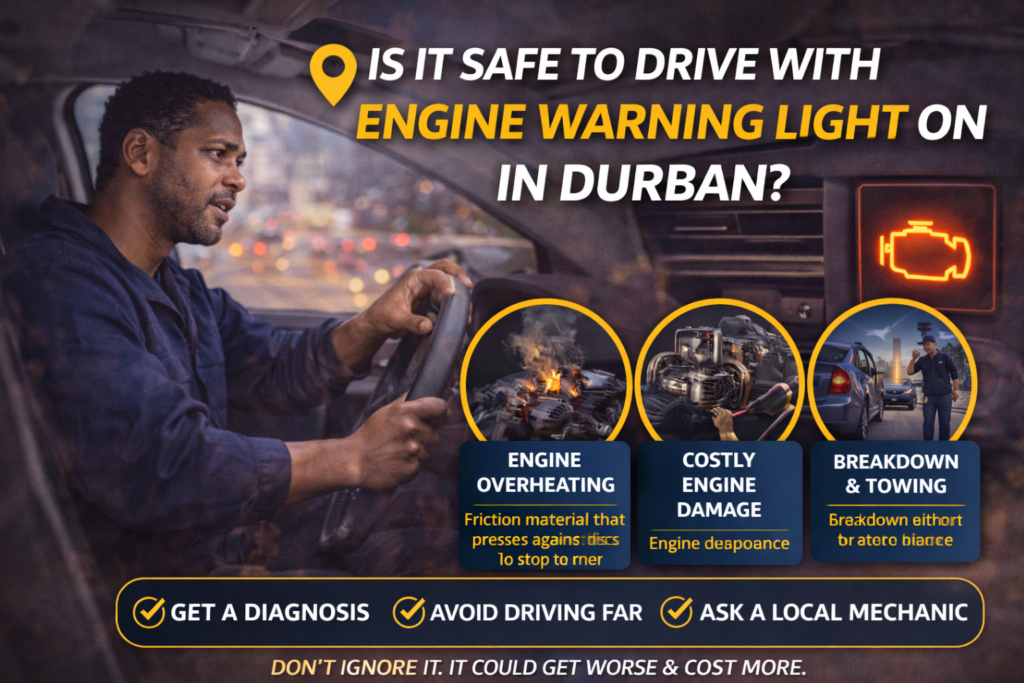
Is It Safe to Drive With Engine Warning Light On in Durban?
When the engine warning light appears on your dashboard, it immediately creates uncertainty. Many Durban drivers continue driving, hoping the issue will disappear, while others panic and stop straight away. In reality, the correct response depends on understanding what the light is actually telling you and how the vehicle is behaving at the time.
The engine warning light is not a fault itself. Instead, it is a signal from your vehicle’s onboard system that something is not operating as expected. Sometimes the issue is minor, but in other cases, it can lead to serious engine damage if ignored. Therefore, knowing how to respond correctly can save you both money and long-term mechanical problems.
Modern vehicles rely heavily on electronic sensors and control modules. Because of this, even small irregularities in engine performance, fuel delivery, or emissions can trigger the engine warning light. However, without proper diagnostics, it is impossible to know whether the issue is harmless or serious.
What the Engine Warning Light Actually Means
The engine warning light is connected to the vehicle’s onboard diagnostics system. This system constantly monitors engine performance using multiple sensors. When one of these sensors detects something outside of normal operating range, it sends a signal to the control unit, which then activates the warning light.
Importantly, the light does not tell you what the problem is. Instead, it tells you that a fault code has been stored. These fault codes need to be read using diagnostic equipment. Without that step, you are essentially guessing the cause, which often leads to replacing the wrong parts.
For example, a simple issue like a loose fuel cap can trigger the light. However, more serious issues such as ignition misfires, fuel system failures, or sensor faults can also activate it. Because of this wide range, a proper car diagnostics check in Durban is always the safest first step.
Understanding the Difference Between a Solid and Flashing Light
Not all engine warning lights should be treated the same. In fact, the way the light behaves gives important clues about the severity of the issue.
A solid engine warning light usually indicates a non-urgent problem. While the vehicle may still be drivable, the issue should not be ignored. Over time, even minor faults can affect fuel efficiency, performance, and emissions.
On the other hand, a flashing engine warning light is far more serious. This often indicates an active engine misfire or a condition that can cause immediate damage. Driving in this state can damage the catalytic converter, increase engine wear, and lead to costly repairs.
Therefore, if the light is flashing, it is strongly advised to stop driving as soon as it is safe and seek assistance immediately.
Common Causes of Engine Warning Lights in Durban Vehicles
There are several reasons why the engine warning light may appear. In Durban, certain driving conditions and vehicle usage patterns can increase the likelihood of specific issues.
One of the most common causes is sensor failure. Sensors such as the oxygen sensor or mass airflow sensor play a key role in managing fuel and air mixtures. When these sensors fail, the engine may run inefficiently, triggering the warning light.
Ignition-related issues are also common. Faulty spark plugs or ignition coils can cause engine misfires, leading to rough running and poor acceleration. In some cases, drivers may also notice hesitation or jerking while driving.
Additionally, fuel system problems such as clogged injectors or fuel pressure issues can trigger the light. In many situations, this is accompanied by reduced performance or difficulty starting the vehicle.
Because these problems can overlap, proper diagnosis is essential rather than assuming the cause.
When It Might Be Safe to Keep Driving
In certain situations, it may be safe to continue driving for a short distance. However, this should only be done if the vehicle is behaving normally and no additional warning signs are present.
For example, if the engine warning light is steady, the vehicle is running smoothly, and there are no unusual noises, overheating, or power loss, it may be possible to drive to a safe location or arrange a check.
Even in these cases, delaying inspection is not recommended. Minor faults can quickly develop into more serious problems if left unresolved.
When You Should Stop Driving Immediately
There are clear situations where continuing to drive is risky and should be avoided.
If the engine warning light is flashing, this is a strong indication of a severe issue. Likewise, if the vehicle experiences sudden power loss, overheating, knocking sounds, or excessive smoke, driving further can cause significant damage.
In these cases, it is far safer to contact an emergency mobile mechanic in Durban rather than attempting to continue driving.
How Ignoring the Warning Light Leads to Bigger Problems
Ignoring the engine warning light often leads to more expensive repairs. What begins as a small issue can escalate quickly.
For instance, a minor misfire can damage the catalytic converter if left unresolved. Similarly, inefficient fuel combustion can increase engine wear over time.
In addition, poor engine performance can affect fuel consumption, leading to higher running costs. Over time, this adds unnecessary strain on multiple components.
Therefore, early diagnosis not only prevents damage but also reduces long-term costs.
How a Mobile Mechanic Diagnoses the Problem Properly
Diagnosing an engine warning light involves more than just reading fault codes. While scanning the vehicle is the first step, proper diagnosis requires interpreting the data and confirming the root cause.
A mobile mechanic will use diagnostic tools to identify stored fault codes. After that, further testing may be required to confirm whether the issue is caused by a faulty sensor, wiring problem, or mechanical failure.
In some cases, related systems such as the charging system may also be involved. For example, issues with the alternator or starter in Durban can indirectly affect engine performance and trigger warning lights.
Preventing Engine Warning Light Problems
Although not all issues can be avoided, regular maintenance significantly reduces the chances of unexpected problems.
Routine servicing helps identify worn components before they fail. Additionally, using quality fuel and addressing small issues early can prevent larger faults from developing.
Regular car servicing in Durban ensures that the engine runs efficiently and reduces the likelihood of warning lights appearing unexpectedly.
Safety Advice for Durban Drivers
- Never ignore a flashing engine warning light
- Avoid long-distance driving with active faults
- Pay attention to changes in performance
- Get professional diagnostics as soon as possible
Frequently Asked Questions
Can I continue driving with the engine warning light on?
Sometimes, but only if the vehicle is running normally and the light is not flashing.
What is the most common cause?
Sensor faults and ignition issues are among the most common causes.
Will the problem fix itself?
No. Even if the light disappears, the underlying issue usually remains.
Need Help With an Engine Warning Light in Durban?
If your engine warning light is on, don’t take chances. We diagnose faults at your location anywhere in Durban and help you avoid unnecessary repairs.