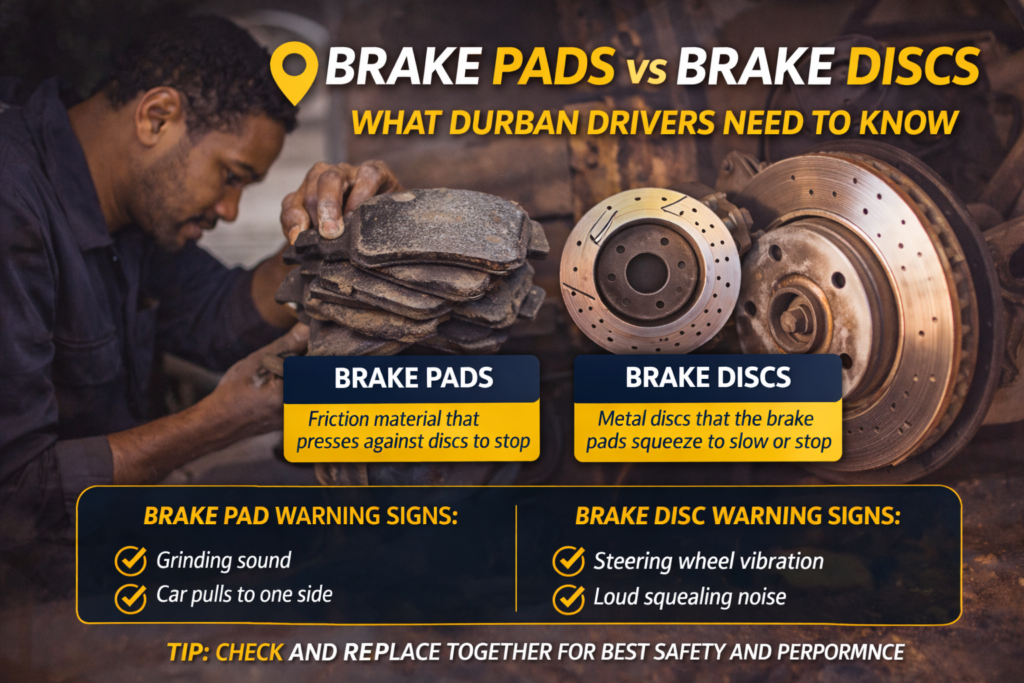
Brake Pads vs Brake Discs – What Durban Drivers Need to Know
Brake problems are never something to leave for later. However, many drivers in Durban are not always sure whether the real issue is the brake pads, the brake discs, or both. That confusion often leads to delayed repairs, unnecessary replacements, or unsafe driving.
This guide explains the difference between brake pads and brake discs, how each part works, the warning signs to watch for, and why proper inspection matters. More importantly, it helps Durban drivers understand when braking problems are minor wear items and when they point to a bigger safety concern.
Your braking system works under constant pressure. Every time you slow down in traffic, stop at an intersection, or control the vehicle on a downhill road, brake pads and brake discs work together to create friction and reduce speed safely. Because both parts wear over time, understanding the difference can save money and improve safety.
What brake pads actually do
Brake pads are the friction components that press against the brake discs when you apply the brakes. In simple terms, they are designed to sacrifice themselves gradually in order to slow the vehicle down. Because they are made from friction material rather than solid metal, they wear faster than discs and need replacement more often.
Every time you brake, the pads clamp onto the rotating disc surface. That friction converts motion into heat, which is how the car loses speed. Over time, the friction material becomes thinner. Eventually, braking performance drops and the risk of disc damage increases. For that reason, brake pads are considered routine wear items and should be inspected before they wear too low.
In busy Durban traffic, this wear can happen faster than many drivers expect. Frequent stopping, school runs, delivery driving, and urban commuting all put extra strain on the pads. As a result, drivers who spend a lot of time in stop-start conditions often need brake pad attention sooner than those who mostly drive open roads.
What brake discs do and why they matter
Brake discs, also called rotors, are the metal discs attached to the wheel hubs. When the brake pads clamp down on them, the discs provide the solid surface needed to create stopping force. Although they are tougher and last longer than brake pads, they are not permanent components. Heat, friction, thickness loss, and uneven wear all affect disc condition over time.
Unlike brake pads, which are expected to wear relatively quickly, brake discs usually wear more gradually. Even so, repeated hard braking, overheating, poor-quality pads, and neglected maintenance can shorten their lifespan. In some cases, discs become grooved or develop uneven surfaces. In other cases, they warp slightly, which may cause vibration when braking.
Therefore, discs are just as important as pads when it comes to safe stopping. Even brand-new pads will not perform properly if the disc surface is damaged, too thin, or uneven.
The real difference between brake pads and brake discs
Many drivers hear the words “pads” and “discs” used together and assume they are almost the same thing. In reality, they perform different jobs and wear at different rates. Brake pads are the friction material. Brake discs are the metal contact surface. Pads normally wear faster. Discs usually last longer but still need inspection and eventual replacement.
Another major difference is how each part tends to fail. Worn pads often cause squeaking, reduced braking power, or grinding once the friction material is too low. By contrast, worn or warped discs often cause vibration, pulsing through the pedal, steering shake during braking, or uneven stopping feel. Consequently, the symptoms can help point to the likely component, although a full inspection is always the safest route.
Understanding this difference matters because many drivers either replace pads too late or assume disc replacement is unnecessary when the discs are already below safe condition.
Quick comparison: brake pads vs brake discs
- Brake pads: friction material that wears faster and is replaced more often
- Brake discs: metal surface that lasts longer but still wears down over time
- Pad symptoms: squeaking, grinding, weaker braking, longer stopping distance
- Disc symptoms: vibration, pulsing, grooves, uneven braking feel
- Inspection need: both should be checked together, not separately guessed
Signs your brake pads may be worn out
Worn brake pads usually provide warning signs before they become dangerous, although not every driver notices them early. One of the most common clues is a squeaking or squealing noise when braking. Many pads are designed with wear indicators that create noise once the friction material becomes too thin. That sound is not something to ignore. Instead, it is an early warning that the pads need inspection.
As wear gets worse, braking can feel less sharp than usual. You may notice that the vehicle takes longer to stop, especially in traffic or on wet roads. In more advanced cases, a harsh grinding sound can appear. That usually means the friction material is worn so low that metal components are contacting the disc. Once that happens, damage can spread beyond the pads and turn a simpler repair into a more expensive one.
Because of that, any noise, reduced response, or unusual braking feel should be checked early through your brake repairs Durban service rather than waiting for total failure.
Signs your brake discs may need attention
Disc issues often feel different from pad issues. Instead of a simple squeak, many drivers notice a vibration through the brake pedal or a shaking sensation through the steering wheel when slowing down. This can happen when discs wear unevenly, become warped through repeated heat cycles, or develop rough spots on the braking surface.
In some vehicles, you may also feel a pulsing sensation during normal braking. That effect often points to irregular disc thickness or a disc surface that is no longer smooth. Visually, badly worn discs may show scoring, grooves, heat marks, or a visible lip around the outer edge. Although some disc wear is expected, excessive damage reduces braking efficiency and affects how evenly the pads can grip.
Consequently, replacing pads alone is not always enough. If the discs are damaged, new pads may wear badly or fail to deliver proper performance from the start.
Why Durban driving conditions can wear brakes faster
Durban driving conditions can be tough on braking systems for several reasons. Firstly, city traffic means repeated braking throughout the day. Every stop at a robot, intersection, shopping centre entrance, or traffic queue creates more pad and disc wear. Secondly, humid coastal air can contribute to surface rust and corrosion, especially if a vehicle stands for periods between drives.
In addition, vehicle load matters. A heavily loaded car, regular school transport, delivery work, or long daily commuting all place extra demand on the brakes. If the vehicle is driven on routes with downhill sections, braking heat builds up even faster. Over time, heat cycling affects both pad life and disc condition.
For that reason, routine car servicing in Durban should include a proper brake inspection rather than waiting for obvious failure symptoms.
Should brake pads and brake discs be replaced together?
This is one of the most common questions drivers ask, and the answer depends on the condition of both components. In some cases, only the brake pads need replacement because the discs are still within safe thickness limits and the braking surface remains smooth and even. In other cases, both parts should be replaced together for the best result.
Replacing both together often makes sense when the discs are worn, grooved, or uneven. It also helps when you want fresh, matched braking surfaces that bed in correctly and perform consistently. On the other hand, installing new pads onto poor discs can reduce pad life, cause noise, and leave braking performance below standard.
Therefore, the correct decision should come from inspection rather than assumption. Measuring disc thickness, checking the surface, and evaluating the condition of the pads is the right way to decide.
How a mobile mechanic checks brake problems properly
A proper brake inspection looks beyond whether the car still stops. Firstly, the pad thickness should be checked. Next, the disc surface and condition should be inspected for grooves, hot spots, scoring, or uneven wear. After that, the mechanic should assess whether the braking feel matches the physical condition of the components.
In addition, other related issues can affect braking performance. Brake fluid condition, caliper function, hose condition, and uneven wear side to side all matter. Sometimes what feels like a pad or disc problem may be partly caused by sticking calipers, poor fluid condition, or suspension-related movement during braking.
If braking concerns appear alongside warning lights or other system behaviour, a car diagnostics check in Durban may also help rule out ABS or related system issues.
Safety section: when brake issues become urgent
Brake problems should never be treated as minor if the vehicle is showing strong warning signs. Grinding noises, heavy vibration, increased stopping distance, pulling during braking, or a weak pedal feel all deserve urgent attention.
- Avoid high-speed driving if braking feels unstable
- Increase following distance immediately
- Do not ignore grinding noises or major vibration
- Get the vehicle checked before daily use continues
- Seek urgent help if braking performance drops suddenly
If the vehicle feels unsafe to drive, contact an emergency mobile mechanic in Durban instead of risking an accident.
Why proper brake maintenance saves money over time
Many brake repairs become expensive only because the early warning signs were ignored. Replacing worn pads at the right time is usually far more affordable than waiting until the pads destroy the discs as well. Likewise, addressing disc wear early can prevent further strain on the rest of the braking system.
Preventative maintenance also improves safety and driving confidence. The vehicle stops more predictably, braking remains smoother, and the risk of surprise failures is reduced. Even more importantly, early inspection helps identify whether the issue is truly pad wear, disc wear, or something else in the system.
In practical terms, regular brake checks are not just a repair issue. They are part of responsible vehicle ownership.
Frequently asked questions
Do brake pads wear faster than brake discs?
Yes. In most vehicles, brake pads wear faster because they are designed as the sacrificial friction material.
Can I replace brake pads without replacing the discs?
Yes, but only if the discs are still in good condition and within safe thickness limits.
What does vibration while braking usually mean?
It often points to disc wear, uneven surfaces, or warping, although a full inspection is needed to confirm the exact cause.
Is squeaking always a sign that the pads are finished?
Not always, but it is a warning sign that should be checked before braking performance worsens.
Need brake help in Durban?
If your brakes are squeaking, vibrating, grinding, or simply not feeling right, get them inspected before the problem becomes more expensive or dangerous. We diagnose brake issues at your location across Durban.